Speakers of a language recognise the grammatical sentences of their language and know how the words in a grammatical sentence must be ordered and grouped. All speakers are capable of producing and understanding an unlimited number of nwe sentences never before spoken or heard. They also recognise ambiguities, know when different sentences mean the seme thing, and correctly preceive the grammatical relations in a sentence such as subject and direct object. This kind of knowledge is accounted for in the grammar by the rules of syntax.
Sentence have structure that can be represented by phrase structure trees containing syntactic categories. Such a representation reveals the linear order of words, and the constituency of each syntactic category. Syntactic categoies are either phrasal categories, such as NP and VP, which can be decomposed into other syntactic categories, or lexical categories, such as noun and verb, which correspond to the words of the language.
A linguistic grammar is a formally stated, explicit description of the mental grammar or speaker's linguistic competence. Phrase structure rules characterise the basic phrase structure tree of the language, the deep structures, and include fact regarding syntactic constituency such as a noun phrase may be a determiner followed by a noun, but never (in English) a noun followed by a determiner.
In phrase structure rules a category that appears on the left side of rule may also occur on the right side. Such rules allow the same syntactic category to appear repeatedly in a phrase structure tree, which reflects a speaker's ability to produce sentences without length limitations.
The lexicon represents the knowledge speakers have about the vocabulary of their language, including the syntactic catrgory of word and what elements may occur together, expressed as subcategorisation restrictions.
Transformational rules are also used to account for the movement of Aux or wh- words to the beginning of interrogative sentence, and other systematic structural relationships that occur among the sentence structures of the language.
To capture the knowledge speakers have about the syntax of their language, the grammar requires, at a minimum, phrase structure rules, a lexicon richly endowed with speakers knowledge about individual words, and a set of transformational rules describing the structure-dependent patterning that occurs throughout the language.
Tampilkan postingan dengan label Syntax. Tampilkan semua postingan
Tampilkan postingan dengan label Syntax. Tampilkan semua postingan
Selasa, 08 April 2014
Sign language syntax
All language have rules of syntax silmilar in kind, if not in detail, to those of English, and sign languages are no exception. A signer is as capable as an oral speaker of distinguishing bog bites man from man bites dog thruogh the order of signing.
Many languages, including English, have a transformation that moves a direct object to the beginning of the sentence to draw particular attention to it, as in :
Many dogs my wife has rescued from the pound.
The transformation is called topicalisation because an object to ehich attention is drawn gegerally becomes the topic of the sentence or conversation. ( The deep structure underlying this sentence is My wife hase many dogs from the pound.)
In sign languages a similar reordering of signs accompanied by raising the eyebrows tilting the head upwards accomplishes the seme effect. The head motion and facial expressions of a signer function as markers of the special word order, much as intonation does in English, or the attachment of prefixes or suffixes might in other languages.
There are constrains on topicalisation similar to those on wh- preposing illustrated in a previous section. The following string is ungrammatical.
Canberra correspondent, John Howard attacked the Herald's.
Compare with the grammatical
The Herald's Canberra correspondent Jhon Howard attacked.
Similar constrain are foun in sign languages. An attempt to sign *Canberra correspondent, Jhon Howard attacked the Herald's would result in an ungrammatical sequence of signs. In thai, to show that an action is being done continuously, the auxiliary verb kamlang is inserted before the verb. Thus kin means 'eat' and kamlang kin means 'is eating'. In English, a form of be is inserted and the main verb changed to a gerund. In sign languages the sign for a verb such as eat may be articulated with a sweeping, repetitive movement to achieve the same effect.
The syntax of all humman languages is complex. It is not the aim of an introductory text to present the specific details of these complexities in this chapter.
Our aim is rathe to expose the complexity of syntactic knowledge that speakers of English or any language must have.
Many languages, including English, have a transformation that moves a direct object to the beginning of the sentence to draw particular attention to it, as in :
Many dogs my wife has rescued from the pound.
The transformation is called topicalisation because an object to ehich attention is drawn gegerally becomes the topic of the sentence or conversation. ( The deep structure underlying this sentence is My wife hase many dogs from the pound.)
In sign languages a similar reordering of signs accompanied by raising the eyebrows tilting the head upwards accomplishes the seme effect. The head motion and facial expressions of a signer function as markers of the special word order, much as intonation does in English, or the attachment of prefixes or suffixes might in other languages.
There are constrains on topicalisation similar to those on wh- preposing illustrated in a previous section. The following string is ungrammatical.
Canberra correspondent, John Howard attacked the Herald's.
Compare with the grammatical
The Herald's Canberra correspondent Jhon Howard attacked.
Similar constrain are foun in sign languages. An attempt to sign *Canberra correspondent, Jhon Howard attacked the Herald's would result in an ungrammatical sequence of signs. In thai, to show that an action is being done continuously, the auxiliary verb kamlang is inserted before the verb. Thus kin means 'eat' and kamlang kin means 'is eating'. In English, a form of be is inserted and the main verb changed to a gerund. In sign languages the sign for a verb such as eat may be articulated with a sweeping, repetitive movement to achieve the same effect.
The syntax of all humman languages is complex. It is not the aim of an introductory text to present the specific details of these complexities in this chapter.
Our aim is rathe to expose the complexity of syntactic knowledge that speakers of English or any language must have.

More about sentence structure
Normal humman minds are such that ... without the help of enybody, they will produce 1000 (sentences) they heard spoke of ... inventing and saying such things as they never hard from their masters, nor any mouth.
Huarte De San Juan,
There are many more structure-dependent relationships in language than can be discussed in an introductory text. In this section we will re-examine some familiar sentences.
Mary insulted Bill.
Bill was insulted by Mary.
The first of pair is an active sentence; the second is passive. There is a systematic relationship between the structure of an active/passive pair :
Here is the phrase structure tree of (1) with the grammatical relations explicitly shown :

Active sentences of the form
Subject V Direct Object
have passive counterparts of the form
Direct Object be V-participle by Subject
where the be agrees with the direct object, which functions as the subject of the passive sentence. The following abbreviated trees illustrate the avtive and corresponding passive structures.

A transformation accounts for part of what English speakers know about the active-passive relationship. It applies to active sentences with the structure shown above, andtransforms them into their passive structure counterparts. This shows that transformations may alter grammatical relations, change verb form, and insert morphemes.
The active sentences are the deep structures. In deep structure the grammatical telations of subject and direct object are interpreted semantically. Since both active and passive sentences have the sema structure, the semantic relationships are the same in both. That is why we understand Mary as the insulter and Bill as the insulted in both the active and passive sentences.
This is a structure-dependent relationship, as all relationships involving transformations are. This may be seen bay making up a nonsense sentence such as
The jabberwocky snicker-snacks the wabe.
and observing that the passive is
The wabe is snicker-snacked by the jabberwocky.
The form of be that occurs in passive sentences in an auxiliary verb. It follows the pattern of Aux when a passive sentence is transformed into its corresponing question :
Is the wabe snicker-snaced by the jabberwocky ?
These examples also illustrate that the order in which transformations occur is significant. The passive transformation must apply first, positioning the was for the interrogative transformation. They could not apply in the reverse order.
Huarte De San Juan,
There are many more structure-dependent relationships in language than can be discussed in an introductory text. In this section we will re-examine some familiar sentences.
Mary insulted Bill.
Bill was insulted by Mary.
The first of pair is an active sentence; the second is passive. There is a systematic relationship between the structure of an active/passive pair :
- The subject of the passive sentence corresponds to the direct object of the active sentence.
- In the passive sentence a form of the verb be appears in front of the main verb, which occurs in its participle from (the form tha occurs after the auxiliary verb have as in she has insulted him; i have taken a bath).
- The subject of the active sentence appears in the passive sentence in a prepositional phrase headed by the preposition by, or it may be omitted altogether.
Here is the phrase structure tree of (1) with the grammatical relations explicitly shown :
Active sentences of the form
Subject V Direct Object
have passive counterparts of the form
Direct Object be V-participle by Subject
where the be agrees with the direct object, which functions as the subject of the passive sentence. The following abbreviated trees illustrate the avtive and corresponding passive structures.
A transformation accounts for part of what English speakers know about the active-passive relationship. It applies to active sentences with the structure shown above, andtransforms them into their passive structure counterparts. This shows that transformations may alter grammatical relations, change verb form, and insert morphemes.
The active sentences are the deep structures. In deep structure the grammatical telations of subject and direct object are interpreted semantically. Since both active and passive sentences have the sema structure, the semantic relationships are the same in both. That is why we understand Mary as the insulter and Bill as the insulted in both the active and passive sentences.
This is a structure-dependent relationship, as all relationships involving transformations are. This may be seen bay making up a nonsense sentence such as
The jabberwocky snicker-snacks the wabe.
and observing that the passive is
The wabe is snicker-snacked by the jabberwocky.
The form of be that occurs in passive sentences in an auxiliary verb. It follows the pattern of Aux when a passive sentence is transformed into its corresponing question :
Is the wabe snicker-snaced by the jabberwocky ?
These examples also illustrate that the order in which transformations occur is significant. The passive transformation must apply first, positioning the was for the interrogative transformation. They could not apply in the reverse order.
Wh sentences
Who's on first ?
That's right !
Bud Abbott and Lou Costello
A different long-distance relationship is illustrated by the following sentences :
Sentence (2) is the deep structure. The fact that who is the direct object of the verb appoint is explicitly revealed in deep structure. In (3), despite the distance between who and appoint, it is understood that who is the direct object. This is accounted for by the transformation together with the fact that (2) is the deep structure that underlies (3).
As in the case of agreement, the distance can be indefinitely long :
Who did Helen say the local member wanted the press secretary to try to convice the treasurer to get the committee to appoint ?
Unlike the agreement situation, the nature of the intervening structure makes a difference in dentence with wh- words such as who, when, what, and which, as shown in the following :
Emily paid a visit to the local member who wants to appoint who ?
Who did Emily pay a visit to the local member who wants to appoint ?
Miss Marple asked Sherlock whether Poirot had solved the crime.
Who did Miss Marple ask whether Poirot had solved the crime ?
Who did Miss Marple ask Sherlock whether had solved the crime ?
What did Miss Marple ask Sherlock whether Poirot had solved ?
John Howard attacked the Herals's Canberra correspondent.
Who did John Howard attack ?
Whose Canberra correspondent did John Howard attack ?
Whose did John Howard attack Canberra correspondent ?
Alice talked to the white rabbit i the afternoon.
Who talked to the white rabbit in the afternoon.
Who did Alice talk to when ?
When did Alice talk to whom ?
Who when did Alice talk to ?
When to whom did Alice talk ?
The constrains on the formation of wh- question are rather complicated, though they are part of every Englis speaker's competence. If this were a book on English syntax, the rules and limitations would have be made explicit.
That's right !
Bud Abbott and Lou Costello
A different long-distance relationship is illustrated by the following sentences :
- Helen said the local member wanted to appoint an assistant
- Helen said the local member wanted to appoint who ?
- Who did Helen say the local member wanted to appoint ?
Sentence (2) is the deep structure. The fact that who is the direct object of the verb appoint is explicitly revealed in deep structure. In (3), despite the distance between who and appoint, it is understood that who is the direct object. This is accounted for by the transformation together with the fact that (2) is the deep structure that underlies (3).
As in the case of agreement, the distance can be indefinitely long :
Who did Helen say the local member wanted the press secretary to try to convice the treasurer to get the committee to appoint ?
Unlike the agreement situation, the nature of the intervening structure makes a difference in dentence with wh- words such as who, when, what, and which, as shown in the following :
Emily paid a visit to the local member who wants to appoint who ?
Who did Emily pay a visit to the local member who wants to appoint ?
Miss Marple asked Sherlock whether Poirot had solved the crime.
Who did Miss Marple ask whether Poirot had solved the crime ?
Who did Miss Marple ask Sherlock whether had solved the crime ?
What did Miss Marple ask Sherlock whether Poirot had solved ?
John Howard attacked the Herals's Canberra correspondent.
Who did John Howard attack ?
Whose Canberra correspondent did John Howard attack ?
Whose did John Howard attack Canberra correspondent ?
Alice talked to the white rabbit i the afternoon.
Who talked to the white rabbit in the afternoon.
Who did Alice talk to when ?
When did Alice talk to whom ?
Who when did Alice talk to ?
When to whom did Alice talk ?
The constrains on the formation of wh- question are rather complicated, though they are part of every Englis speaker's competence. If this were a book on English syntax, the rules and limitations would have be made explicit.
Long-distance relationships
Anyone who has had a gerl- or boyfriend or a spouse living in another city probably cringers at the idea of long-distance relationships. But They are indispensable to the grammar of English.
Consider first the following sentences :
The guy seems kind of cute.
The guys seems kind of cute.
The verb has-s added whenever the subject is third person singular. Such a relationship is called agreement or subject-verb agreement.
Now consider these sentences :
The guy we met at the party next door seems kind of cute.
The guys we met at the party next door seem kind of cute.
The verb seem must agree with the subject, The guy or The guys, and that agreement takes place over a long distance. In the example above, the distance encompassed is we met at the party next door, but there is no limit to how many words may intervene, as the following sentence illustrates :
The guys (guy) we met at the party next dorr that lasted until 3a.m and was finally broken up by the cops who were called by the neighbours seem (seems) kind of cute.
This aspect of linguistic competence is explained by the phrase structure tree of such a sentence, which is shown below omitting much detail :

In the tree, ' ====== ' represents the intervening structure, which may, in principle, be indefinitely long and complex. But speakers of English know that agreement depends on sentence structure, not the linear order of words. Agreement is between the subject, structurally defined as the NP immediately below the S, and the main verb, structurally defined as the verb in the VP immediately below the S. Other material can be ignored as far as the rule of agreement is concerned, although in actual performance, if the distance is too great, the speaker may forget what the head noun was.
Consider first the following sentences :
The guy seems kind of cute.
The guys seems kind of cute.
The verb has-s added whenever the subject is third person singular. Such a relationship is called agreement or subject-verb agreement.
Now consider these sentences :
The guy we met at the party next door seems kind of cute.
The guys we met at the party next door seem kind of cute.
The verb seem must agree with the subject, The guy or The guys, and that agreement takes place over a long distance. In the example above, the distance encompassed is we met at the party next door, but there is no limit to how many words may intervene, as the following sentence illustrates :
The guys (guy) we met at the party next dorr that lasted until 3a.m and was finally broken up by the cops who were called by the neighbours seem (seems) kind of cute.
This aspect of linguistic competence is explained by the phrase structure tree of such a sentence, which is shown below omitting much detail :
In the tree, ' ====== ' represents the intervening structure, which may, in principle, be indefinitely long and complex. But speakers of English know that agreement depends on sentence structure, not the linear order of words. Agreement is between the subject, structurally defined as the NP immediately below the S, and the main verb, structurally defined as the verb in the VP immediately below the S. Other material can be ignored as far as the rule of agreement is concerned, although in actual performance, if the distance is too great, the speaker may forget what the head noun was.
Transformational rules
Method consists entirely in properly ordering and arranging the things to which we should pay attention.
Rene Descartes
Consider the following sentences :

Both mean the same thing despite the position of the adverb. The phrase structure rules place the adverb at the end of the VP, thereby accounting for (1). How can (2) be accounted for ? If we suggest a phrase structure rule with two optional adverbs, like this :
VP --- (Adv) V (NP) (PP) (Adv)
we are faced with the unacceptable possibility of generating ungrammatical strings such as :
The father cleverly wept bitterly.
A solution to this problem is to allow the phrase structure rules to generate the adverb in VP final position, and have another formal device, called a transformational rule, move the adverb in front of the verb, thus deriving the structure that represents (2) from the structure that represents (1).
The basic sentences of the language, whose phrase structure trees are called deep structures, are specified by the phrase structure rules. Variants on those basic sentence structures are derived via transformations.
The structures of sentences that we actually spak--to which the rules of phonology are applied--are called surface structures. If no transformation apply then surface structure is the end result after all transformations have had their effect.
Above, the (1) tree is the deep structure, underlying both sentences (1) and (2). The surface structure of (1) is the same as its deep structure because no transformation has been applied to it. The surface structure of (2), however, is the (2) tree because the adverb-moving transformation alters its deep structure.
According to the same transformational theories, certain obligatory transformations apply to all deep structures. Thus deep and surface are never identical. In this introductory treatment we are unable to provide such details.
Much syntactic knowledge not revealed by phrase structure rules in accounted for by transformations, which alter phrase structure trees by moving, adding, or deleting elements. In particular, families of structurally related sentences are revealed by virtue of havinf the same deep structure, with surface structure differences created by transformational rules.
A transformation similar to the one that moves adverbs moves prepositional phrases when they occur immediately under the VP. It would be responsible foe In the house, the puppy found the ball, and so on.
Further proof of the structure dependency of transformations is the fact that With a telescope, the boy saw the man is not ambiguous. It has only the meaning 'the boy used a telescope to see the man', the meaning corresponding to the phrase structure in which the PP is immediately under the VP. The structure corresponding to the other meaning 'the boy saw the man who had a telescope' has its PP in the NP. The transformation does not apply to it because the structural requirements are not met.
Another transformation deletes that when it precedes a sentence in direct object position, but not in subject position, as illustrated by these pairs :
I know that you know.
I know you know.
That you know bothers me
You know bothers me
This is a further demonstration that transformations are structure dependent. Trasformations also reveal speaker knowledge about the systematic relationship between statements and questions. Consider again the following :
The boy is sleeping.
The boy can sleep.
The boy will sleep.
Word such as is, can, and will are in a class of auxiliary verbs (Aux), which includes be and have as well as may, might, would, could and several others. They are sometones referred to as helping verbs auxiliary modals. They occur in such structures as this one :
We haven't given the S-rule for this structure. It would be S--- NP Aux VP.

Now consider the interrogative sentences corresponding to the declarative ones just given :
Is the boy sleeping ?
Can the boy sleep ?
Will the boy sleep ?
The interrogratives are related to their declarative counterparts in a simple way. In the questions the Aux occurs at the beginning of the sentence rather than after the subject NP.
This relationship can be accounted for by a trasformation that moves the Aux to the front of the sentence. Phrase structure rules need only generate declarative sentence as deep structures. S transformation derives the surface structure of the corresponding interrogatives.
Consider now the following declaratife/intrrogative sets of sentences :
The boy who is sleeping was dreaming.
Was the boy who is sleeping dreaming ?
Is the boy who sleep was dreaming ?
The who can sleep will dream.
Will the boy who can sleep dream ?
Can the boy who will sleep dream ?
The ungrammatical sentences show that in forming question it is the auxiliary of the tpomost S, that is, the one following the entire first NP, that appears at the front of the sentence, not simply the first auxiliary in the sentence. This is illustrated in the following simplified phrase structure trees.

This is further evidence that syntactic categories such as noun phrase are basic structures in language. It is also further evidence of the structure-dependent nature of transformational rules. Transformations such as the one for forming questions must refer to structure, and not only true in English. Simillar constrains and similar rules occur in other languages, as shown by the folowing sentences in Spanish :
El hombre esta en la casa.
The man is in the house.
Esta el hombre en la casa ?
Is the man in the house ?
El hombre esta contento.
The man is happy.
Esta el hombre contento ?
Is the man happy ?
El hombre, que este contento, esta en la casa.
The man, who is happy, in the house.
Esta el hombre, que esta contento, en la casa ?
Is the man, who is happy, in the house ?
Esta el hombre, que contento, esta en la casa ?
Is the man, who happy, is in the house ?
More than one transformation may act on a deep structure. When they do, they do so one after the other. Cosider is the father silently weeping ? Its deep structure is the father is weeping silently. The adverb-moving transformation produces the underlying structure the father is silently weeping. The question transformation acts on this structure to produce the surface structure is the father silently weeping ? This is illustrated in the following diagram :


.
Rene Descartes
Consider the following sentences :
- The fathe wept silently.
- The father silently wept.
Both mean the same thing despite the position of the adverb. The phrase structure rules place the adverb at the end of the VP, thereby accounting for (1). How can (2) be accounted for ? If we suggest a phrase structure rule with two optional adverbs, like this :
VP --- (Adv) V (NP) (PP) (Adv)
we are faced with the unacceptable possibility of generating ungrammatical strings such as :
The father cleverly wept bitterly.
A solution to this problem is to allow the phrase structure rules to generate the adverb in VP final position, and have another formal device, called a transformational rule, move the adverb in front of the verb, thus deriving the structure that represents (2) from the structure that represents (1).
The basic sentences of the language, whose phrase structure trees are called deep structures, are specified by the phrase structure rules. Variants on those basic sentence structures are derived via transformations.
The structures of sentences that we actually spak--to which the rules of phonology are applied--are called surface structures. If no transformation apply then surface structure is the end result after all transformations have had their effect.
Above, the (1) tree is the deep structure, underlying both sentences (1) and (2). The surface structure of (1) is the same as its deep structure because no transformation has been applied to it. The surface structure of (2), however, is the (2) tree because the adverb-moving transformation alters its deep structure.
According to the same transformational theories, certain obligatory transformations apply to all deep structures. Thus deep and surface are never identical. In this introductory treatment we are unable to provide such details.
Much syntactic knowledge not revealed by phrase structure rules in accounted for by transformations, which alter phrase structure trees by moving, adding, or deleting elements. In particular, families of structurally related sentences are revealed by virtue of havinf the same deep structure, with surface structure differences created by transformational rules.
A transformation similar to the one that moves adverbs moves prepositional phrases when they occur immediately under the VP. It would be responsible foe In the house, the puppy found the ball, and so on.
Further proof of the structure dependency of transformations is the fact that With a telescope, the boy saw the man is not ambiguous. It has only the meaning 'the boy used a telescope to see the man', the meaning corresponding to the phrase structure in which the PP is immediately under the VP. The structure corresponding to the other meaning 'the boy saw the man who had a telescope' has its PP in the NP. The transformation does not apply to it because the structural requirements are not met.
Another transformation deletes that when it precedes a sentence in direct object position, but not in subject position, as illustrated by these pairs :
I know that you know.
I know you know.
That you know bothers me
You know bothers me
This is a further demonstration that transformations are structure dependent. Trasformations also reveal speaker knowledge about the systematic relationship between statements and questions. Consider again the following :
The boy is sleeping.
The boy can sleep.
The boy will sleep.
Word such as is, can, and will are in a class of auxiliary verbs (Aux), which includes be and have as well as may, might, would, could and several others. They are sometones referred to as helping verbs auxiliary modals. They occur in such structures as this one :
We haven't given the S-rule for this structure. It would be S--- NP Aux VP.
Now consider the interrogative sentences corresponding to the declarative ones just given :
Is the boy sleeping ?
Can the boy sleep ?
Will the boy sleep ?
The interrogratives are related to their declarative counterparts in a simple way. In the questions the Aux occurs at the beginning of the sentence rather than after the subject NP.
This relationship can be accounted for by a trasformation that moves the Aux to the front of the sentence. Phrase structure rules need only generate declarative sentence as deep structures. S transformation derives the surface structure of the corresponding interrogatives.
Consider now the following declaratife/intrrogative sets of sentences :
The boy who is sleeping was dreaming.
Was the boy who is sleeping dreaming ?
Is the boy who sleep was dreaming ?
The who can sleep will dream.
Will the boy who can sleep dream ?
Can the boy who will sleep dream ?
The ungrammatical sentences show that in forming question it is the auxiliary of the tpomost S, that is, the one following the entire first NP, that appears at the front of the sentence, not simply the first auxiliary in the sentence. This is illustrated in the following simplified phrase structure trees.
This is further evidence that syntactic categories such as noun phrase are basic structures in language. It is also further evidence of the structure-dependent nature of transformational rules. Transformations such as the one for forming questions must refer to structure, and not only true in English. Simillar constrains and similar rules occur in other languages, as shown by the folowing sentences in Spanish :
El hombre esta en la casa.
The man is in the house.
Esta el hombre en la casa ?
Is the man in the house ?
El hombre esta contento.
The man is happy.
Esta el hombre contento ?
Is the man happy ?
El hombre, que este contento, esta en la casa.
The man, who is happy, in the house.
Esta el hombre, que esta contento, en la casa ?
Is the man, who is happy, in the house ?
Esta el hombre, que contento, esta en la casa ?
Is the man, who happy, is in the house ?
More than one transformation may act on a deep structure. When they do, they do so one after the other. Cosider is the father silently weeping ? Its deep structure is the father is weeping silently. The adverb-moving transformation produces the underlying structure the father is silently weeping. The question transformation acts on this structure to produce the surface structure is the father silently weeping ? This is illustrated in the following diagram :
.
Senin, 07 April 2014
Sentence relatedness
Most wonderful all are ... [sentences], and how they friends one with another.
O. Henry
Sentences may be related in various ways. For example, they may have the sama phrase structure, differing only in their words, which accounts for their differing meaning. We saw this earlier in sets of sentences such as The boat sailed up the river, A girl laughed at the monkey, and so on.
Two sentences with different meanings may contain the same words in the same order, differing only in structure, for example, The boy saw the man with the telescope. These are cases of structural ambiguity.
Two sentences may differ in structure, possibly with small differences in grammatical morphemes, but with no diference in meaning :
The father wept silently.
The father silently wept.
The astronomer saw a new galaxy with his telescope.
With his telescope the astronomer saw a new galaxy.
Mary insulted Bill
Bill was insulted by Mary
I know that you know
I know you know
Two sentence may have structural differences that correspond systematically to meaning difference.
The boy is sleeping.
Is the boy sleeping ?
The boy can sleep.
Can the boy sleep ?
The boy will sleep.
Will the boy sleep ?
The man is in the house.
Is the man in the house ?
The difference in the position of the verbal element is, can, will, corresponds to whether the sentence is declarative or inerrogative.
Phrase structure rules account for much syntactic knowledge, but they do not account for the fact that Mary insulted Bill has the same meaning as Bill was insulted by Mary, but a different meaning from Mary was insulted by Bill. Nor do they account for the systematic difference between statements knowledge, we must look beyond phrase structure rules.
O. Henry
Sentences may be related in various ways. For example, they may have the sama phrase structure, differing only in their words, which accounts for their differing meaning. We saw this earlier in sets of sentences such as The boat sailed up the river, A girl laughed at the monkey, and so on.
Two sentences with different meanings may contain the same words in the same order, differing only in structure, for example, The boy saw the man with the telescope. These are cases of structural ambiguity.
Two sentences may differ in structure, possibly with small differences in grammatical morphemes, but with no diference in meaning :
The father wept silently.
The father silently wept.
The astronomer saw a new galaxy with his telescope.
With his telescope the astronomer saw a new galaxy.
Mary insulted Bill
Bill was insulted by Mary
I know that you know
I know you know
Two sentence may have structural differences that correspond systematically to meaning difference.
The boy is sleeping.
Is the boy sleeping ?
The boy can sleep.
Can the boy sleep ?
The boy will sleep.
Will the boy sleep ?
The man is in the house.
Is the man in the house ?
The difference in the position of the verbal element is, can, will, corresponds to whether the sentence is declarative or inerrogative.
Phrase structure rules account for much syntactic knowledge, but they do not account for the fact that Mary insulted Bill has the same meaning as Bill was insulted by Mary, but a different meaning from Mary was insulted by Bill. Nor do they account for the systematic difference between statements knowledge, we must look beyond phrase structure rules.
More lexical differences
Different words engender different syntactic behaviour, and this aspect of speaker knowledge is represented in the lexicon. The verbs of English occur in a wide variety of syntactic patterns. For example, the verb want and force appear to be similar when we consider such sentence as
The conductor wanted the passengers to leave.
The conductor forced the passengers to leave.
but they differ in another syntactic context :
The conductor wanted to leave.
The condoctor forced to leave.
Try exhibits a thied pattern differing form both want and force in that it is never followed directly by an NP :
The conductor tried him to leave.
Try is, however, similar to want, but not force, in that it can be directly followed by an infinitive (that is, the 'to' form of the verb): the conductor tried to leave.
These differing syntactic patterns of verbs are also specified in the lexicon, thus accounting explicitly for the knowledge spaekers have about these words.
The example given show only a single verb for each pattern, but each verb cited is representative of a class of verbs. For example, expect, need, and wish pattern ina similar way to want; allow,order and persuade pattern in a similar way to force; and condescend, decide, and manage pattern in a similar way to try. Another instance of syntactically based lexical difference is found in the patterns in which believe and say appear, which are quite different from those of want-, force-, and try-class verb :
The teacher believe susan is outstanding.
The teacher say susan is outstanding.
The teacher believe susan to be outstanding
Both believe and say may be followed by a complete sentence. However, only believe can be followed by a 'sentence' in which the verb occurs as an infinitive. As in the previous case, these patterns are repersentative of classes of verbs: suppose and think are like believe; forget and insist are like say. A generalisation emerges when the following example are considered :
The teacher believe themselves to be outstanding.
The teacher say themselves to be outstanding.
Believe-class verbs, but not say-class verbs, can be followed by a reflexive pronoun, a pronoun ending with -selft. The differences in syntactic patterns are part of the lexical rppresentation of these verbs.
The lexicon is a key component in the grammar, containing vast amounts of information on individual words.
The conductor wanted the passengers to leave.
The conductor forced the passengers to leave.
but they differ in another syntactic context :
The conductor wanted to leave.
The condoctor forced to leave.
Try exhibits a thied pattern differing form both want and force in that it is never followed directly by an NP :
The conductor tried him to leave.
Try is, however, similar to want, but not force, in that it can be directly followed by an infinitive (that is, the 'to' form of the verb): the conductor tried to leave.
These differing syntactic patterns of verbs are also specified in the lexicon, thus accounting explicitly for the knowledge spaekers have about these words.
The example given show only a single verb for each pattern, but each verb cited is representative of a class of verbs. For example, expect, need, and wish pattern ina similar way to want; allow,order and persuade pattern in a similar way to force; and condescend, decide, and manage pattern in a similar way to try. Another instance of syntactically based lexical difference is found in the patterns in which believe and say appear, which are quite different from those of want-, force-, and try-class verb :
The teacher believe susan is outstanding.
The teacher say susan is outstanding.
The teacher believe susan to be outstanding
Both believe and say may be followed by a complete sentence. However, only believe can be followed by a 'sentence' in which the verb occurs as an infinitive. As in the previous case, these patterns are repersentative of classes of verbs: suppose and think are like believe; forget and insist are like say. A generalisation emerges when the following example are considered :
The teacher believe themselves to be outstanding.
The teacher say themselves to be outstanding.
Believe-class verbs, but not say-class verbs, can be followed by a reflexive pronoun, a pronoun ending with -selft. The differences in syntactic patterns are part of the lexical rppresentation of these verbs.
The lexicon is a key component in the grammar, containing vast amounts of information on individual words.
Subcategorisation
The lexicon contains more syntactic information than merely the lexical category of each word. If it did not, speakers of English would be unable to make the following grammaticality distinctions
The boy found the ball.
The verb find is a transitive verb. A transitive verb must be followed by a noun phrase, its direct object. This additional specification is called subcategorisation and is also included in the lexical enty of each word.
Most words in the lexicon are subcategorised for certain contexts. Subcategorisation accounts for the ungrammaticality of :
Other categories besides verbs are subcategorised. For example, within the NP, if the determiner is lacking, only a plural noun (or proper name ) may be inserted; and if the determiner is a, only a singular noun may be iserted. This accounts for the following :
Puppies love warm milk.
Subcategorisation within the NP affects individual nouns. Belief is subcategorised for both a PP at an S, as shown by the following ttwo examples :
the belief in freedom of speech
the belief that freedom of speech is a basec right
The noun sympathy, however, is subcategorised for a PP, but not an S :
their sympathy for the victims
A fragment of the lexicon
put, V, ________ NP PP
find, V, ________ NP
sleep, V, ________
belief, N, ________ (PP), _____ (S)
sympathy, N, ________ (PP)
Comments
put, is a verb and must be followed by both an NP and a PP within the verb phrase.
find, is a verb and must be followed by an NP within the verb phrase.
sleep, is a verb abd must not be followed by an NP within the verb phrase
belief, is a noun and may be followed by either a PP or am S within the noun phrase
sympathy, is a noun and may be followed by a PP within the noun phrase
Just as lexical insertion ensures that verbs are inserted under a V node in a tree, nouns under an N node, and so on, it also ensures that, for example, intransitive verbs such as sleep can only appear in trees in which the VP has no direct object. Similarly, put could only occur in trees where it would be followed by an NP and a PP within tha verb phrase, and so on.
The boy found the ball.
- The boy found quickly.
- The boy found in the house.
The verb find is a transitive verb. A transitive verb must be followed by a noun phrase, its direct object. This additional specification is called subcategorisation and is also included in the lexical enty of each word.
Most words in the lexicon are subcategorised for certain contexts. Subcategorisation accounts for the ungrammaticality of :
- John put the milk.
- Sylvia slept the baby.
Other categories besides verbs are subcategorised. For example, within the NP, if the determiner is lacking, only a plural noun (or proper name ) may be inserted; and if the determiner is a, only a singular noun may be iserted. This accounts for the following :
Puppies love warm milk.
- Puppy loves warm milk.
- A puppies love warm milk.
Subcategorisation within the NP affects individual nouns. Belief is subcategorised for both a PP at an S, as shown by the following ttwo examples :
the belief in freedom of speech
the belief that freedom of speech is a basec right
The noun sympathy, however, is subcategorised for a PP, but not an S :
their sympathy for the victims
- their sympathy that the victims are so poor
A fragment of the lexicon
put, V, ________ NP PP
find, V, ________ NP
sleep, V, ________
belief, N, ________ (PP), _____ (S)
sympathy, N, ________ (PP)
Comments
put, is a verb and must be followed by both an NP and a PP within the verb phrase.
find, is a verb and must be followed by an NP within the verb phrase.
sleep, is a verb abd must not be followed by an NP within the verb phrase
belief, is a noun and may be followed by either a PP or am S within the noun phrase
sympathy, is a noun and may be followed by a PP within the noun phrase
Just as lexical insertion ensures that verbs are inserted under a V node in a tree, nouns under an N node, and so on, it also ensures that, for example, intransitive verbs such as sleep can only appear in trees in which the VP has no direct object. Similarly, put could only occur in trees where it would be followed by an NP and a PP within tha verb phrase, and so on.
The lexicon
We next went to the school of languages, where three professors sat in consultation upon improving that of their own country.
The first project was to shorten discourse by cutting polysyllables into one, and leaving out verbs and participles; because in reality all things imaginable are but nouns.
The other was a scheme for entirely abolishing all words whatsoever; and this was urged as a great advantage in point of health as wall as brevity. For it is plain, that every word we speak is in some degree a diminution od our lungs by corrison
Jonathan Swift
The learned professors of languages in Laputa proposed a scheme for abolishing all words, thinking itr would be more convenient if 'Men [were] to carry about them such things as were necessary to express the particular business they are to discourse on'. We doubt that this svheme could ever come to fruition, even in laputa, not only because it would be difficult to carry around an unobservable atom or an abstract loyalty, but because our thoughts are expressed by sentences that have structure and cannot be representred by things pulled from a sack.
Speaker of any language know thousands of words. They know how to pronounce them in all conexts, they know their meaning, and they know how to combine them in phrases or sentences, which means that they know their syntactic category. All of this knowledge is contained in the component of the grammar called lexicon.
Together with the phrase structure rules, the lexicon provides the information needed for complete, well-formed phrase structure trees. The phrase structure rules account for the entire except for the words at the bottom. The words in the tree belong to the samy syntactic categories that appear immediately above them. Through lexical insertion, words of the specified as verbs in the lexicon are inserted under a note labelled verb, and so on. Words such as fish, which belong to two or more categories, have seperate entries in the lexicon, or are marked for both categories in their single listing.
The first project was to shorten discourse by cutting polysyllables into one, and leaving out verbs and participles; because in reality all things imaginable are but nouns.
The other was a scheme for entirely abolishing all words whatsoever; and this was urged as a great advantage in point of health as wall as brevity. For it is plain, that every word we speak is in some degree a diminution od our lungs by corrison
Jonathan Swift
The learned professors of languages in Laputa proposed a scheme for abolishing all words, thinking itr would be more convenient if 'Men [were] to carry about them such things as were necessary to express the particular business they are to discourse on'. We doubt that this svheme could ever come to fruition, even in laputa, not only because it would be difficult to carry around an unobservable atom or an abstract loyalty, but because our thoughts are expressed by sentences that have structure and cannot be representred by things pulled from a sack.
Speaker of any language know thousands of words. They know how to pronounce them in all conexts, they know their meaning, and they know how to combine them in phrases or sentences, which means that they know their syntactic category. All of this knowledge is contained in the component of the grammar called lexicon.
Together with the phrase structure rules, the lexicon provides the information needed for complete, well-formed phrase structure trees. The phrase structure rules account for the entire except for the words at the bottom. The words in the tree belong to the samy syntactic categories that appear immediately above them. Through lexical insertion, words of the specified as verbs in the lexicon are inserted under a note labelled verb, and so on. Words such as fish, which belong to two or more categories, have seperate entries in the lexicon, or are marked for both categories in their single listing.
More phrase structure rules

Thera are many sentences of English whose structure is not accounted for by the phrase structure rules given so far, including :
- Pretty girls whispered softly.
- The man with the hat smiled
- The teacher believes that the student knows the answer.

From this example we see that a determiner is optional in the NP. Moreover, two new lexical categories appear: adjective (Adj) and adverb (Adv). both optional. All this suggest modifications to both the NP rule and the VP rule :
NP --- (Det) (Adj) N2
VP --- V (NP) (PP) (Adv)
The addition of an optional adverb to the VP rule allows for four more sentence types :
The wind blew softly.
The wind swept through the trees noisily.
The wind rattled the windows violently.
The wind forced the boat into the water suddenly.
The NP in sentence (2), the man with the hat, is similar to the man with the telescope seen earlier, and has the following structure :

The NP rule can modified once to include the option of a prepositional phrase :
NP --- (Det) (Adj) N (PP)
Sentence (3) contains another sentence within it self. The inside sentence, the student knows the answer, is embedded in the larger sentence The teacher believes that the student knows the answer. What sould the phrase structure of this sentence be ? Before we attempt to answer this question, we should look at some other data.
As pointed out earlier, any number of adjectives may be strung together. For simplicity our rules will allow only one adjective and would need to be changed to fully account for Englis speakers knowledge.
That the student knows the answer is believed by the teacher.
That the student knows the answer disturbed the teacher.
In both cases the expression that the student knows the answer patterns like a noun phrase. Compare :
The child is believed by the teacher.
The child disturbed the teacher.
These example suggest that by putting the word that in front of a sentence, in will function like an NP. The phrase structure tree for (3), then, is :

We omit the internal structure of the embeded sentence because it's not relevant. Another NP phrase structure rule is suggested :
NP --- that S
This rule is different from previous rules in that it contain a word (that) rather than a category. In the next section we'll se how words are put into phrase structure trees in general. This rule is a special case.
We now see how the ability all speakers have to embed sentences within sentences, as illustrated by the cartoon at the beginning of this section, is chaptured.
here is an illustrative phrase structure tree :

We need one final NP rules we have discussed so far. These are all the phrase structure rules we will present in this chapter :
- S --- NP VP
- NP --- (Det) (Adj) N (PP)
- NP --- that S
- NP --- Pronoun
- VP --- V (NP) (PP) (Adv)
- PP --- P NP
A complete grammar of English would have many more such rules. However, even this mini-grammar can specify an infinite number of possible sentences due to the fact that several categories (S, NP,VP) appear on both the left and right sides of several rules. Thus the rules explain our memories can still produce and understand an infinite set of sentences.
There are still many sentence type of English not encompassed by these rules. Only in passing have we mentioned verbal elements such as the auxiliary verbs have or may in sentences such as He may have left early.
Nor have we explicitly accounted for the many types of determiners besides the articles the and a that may precede the noun in a noun phrase such as each, several, these, many of michael Jackson's, and so on.
Each boy found several eggs.
These girl sang many of michael jackson's songs.
Rules (3) and (5) show that a whole sentence preceded by the word that may be embeded in a VP. In other data, different forms of sentence may be embeded in the VP. (Their source is beyond the scope of this introduction.)
Hillary is waiting for you to sing. ( Cf. You sing.)
The host regrets the judge's having left early. (Cf. the judge has left early.)
The hostess wants the judge to laeve early. (Cf. The judge leaves early.)
Rules in other languages
Whenever the literary German dives into a sentence, that is the last you are going to see of him till he emerges on the other side of the Atlantic with his Verb in his mouth.
Mark Twain
Other languages have different phrase structure rules, hence different tree structures. In swedish the determiner may follow the noun in some NPs, for example, in mannen, 'the man' (mann, 'man', + en, 'the' ). The ungrammatical tree of English is a grammatical tree structure in Swedish :

The grammar of Japanese cntains the phrase structure rule
PP---NP P
but not the rule
PP --- P NP
Such differences between these languages and English are reflected in the phrase structure rules of the respective grammars.
In English the verb is always the first member of the verb phrase, as can be seen form the VP rule. In German, however, the verb may contains sentences such as
Ich glaube dass Tristan Isolde liebt.
which, if translated word for word, would be 'I believe that Tristan Isolde loves' meaning 'I believe that Tristan loves Isolde'.
Despite these differences in detail, all grammars of all languages have the type of rule we are calling a phrase structure rule, which characterises the structure of phrase, sentences, and syntactic categories of the language.
Mark Twain
Other languages have different phrase structure rules, hence different tree structures. In swedish the determiner may follow the noun in some NPs, for example, in mannen, 'the man' (mann, 'man', + en, 'the' ). The ungrammatical tree of English is a grammatical tree structure in Swedish :
The grammar of Japanese cntains the phrase structure rule
PP---NP P
but not the rule
PP --- P NP
Such differences between these languages and English are reflected in the phrase structure rules of the respective grammars.
In English the verb is always the first member of the verb phrase, as can be seen form the VP rule. In German, however, the verb may contains sentences such as
Ich glaube dass Tristan Isolde liebt.
which, if translated word for word, would be 'I believe that Tristan Isolde loves' meaning 'I believe that Tristan loves Isolde'.
Despite these differences in detail, all grammars of all languages have the type of rule we are calling a phrase structure rule, which characterises the structure of phrase, sentences, and syntactic categories of the language.
Trees that won't grow
Just as speakers know whick structures and strings of words are permitted by the syntax of their language, they know which are not. Such knowledge is specified implicitly by the phrase structure rules.
Since the rule S --- NP VP is the only S rule in our (simplified) grammar of English, the following word sequences and their corresponding structures do not constitute English sentences.


Note : Non-pertinent parts of the tree are sometimes omitted, in this case the Det and N of the NP, a buffalo.

Similarly, boy the

cannot ba an NP in English because no NP rule of English syntax specifies that a determiner can follow a noun.
Since the rule S --- NP VP is the only S rule in our (simplified) grammar of English, the following word sequences and their corresponding structures do not constitute English sentences.
Note : Non-pertinent parts of the tree are sometimes omitted, in this case the Det and N of the NP, a buffalo.
Similarly, boy the
cannot ba an NP in English because no NP rule of English syntax specifies that a determiner can follow a noun.
The relationship between phrase structure rules and phrase structure trees
I think that i shall never see
A poem lovely as a tree
Joyce Kilmer
Phrase structure trees may not be as lovely to look at as the trees Kilmer wa thinking of, but if a poem is written in grammatical English, its phrase and sentences can be represented by trees, and those trees can be specified bu phrase structure rules.
The rules that we have discussed, repeated here, define some of the phrase structure trees of English.
S --- NP VP
NP --- Det N
VP --- V (NP) (PP)
PP --- P NP
There are several possible ways of viewing phrase structure rules. They can be regarded as tests that trees must pass to be grammatical. Each syntactic category mentioned in the tree is examined to see if the syntactic categories immediately beneath it agree with the phrase structure rules. If we were examining an NP in atree, it would pass the test if the categories beneath it were Det and N, in that order, and fail the test otherwise, insofar as our (incompete) set of phrase structure rules is concerned. (Obviously, in a more adequate grammar of English, NPs would be specified to include many more structures.)
The rules may also be viewed as a way to construct phrase structure trees that conform to the syntactic structures of the language. This is by no means suggestive of how speakers actually produce sentences. It is just another way of representing their knowledge, and it applies equally to speakers and listeners.
Conventions on generating trees have been developed. Generating as used here simply means 'specifying'. One convention is that the root of the tree, the S, occurs at the top instead of the bottom. Another convention specifies how the rules are to be applied. First, find a rule with an S on the left side of the arrow, and put the categories on the right side below the S, as shown here :

Once you have started, continue by matching any syntactic category at the bottom of the partially constructed tree to a category on the left side of a rule, and expanding the tree with the categories on the right sde. Proceed in this manner until only categories remain that never appear on the left-hand side of any rule, such as Det, N, and so on.
We may expand the tree started above by applying the NP rule to produce :

The categories at the bottom are Det, N, and VP, but only VP occurs to the left of an arrow in the set of rules. The VP rule is actually four rules abbreviated by parentheses. They are :
VP --- V
VP --- V NP
VP --- V PP
VP --- V NP PP
Any one of them may be chosen to apply next ; the order in which the rules appear in the grammar is irrelevant. ( Indeed, we might equally have begun by expanding the VP rather that the NP. ) Suppose VP --- V PP is chosen to apply. Then the tree has grown to look like this :

Convention dictates that we continue in this way until none of the categories. at the bottom of the tree appear on the left-hand side of any rule. Thus the PP must be expanded into a P and an NP, and that NP expanded into a Det and an N. We can use a rule as many times ats it can apply. In this tree, the NP rule was used twice. Sfter we have applied all the rules that can apply, the tree looks like this :

By following these conventions, only trees specified by the phrase structure rules can be generated. By implication, any tree not so specifies will be ungrammatical. Whether we choose to use the rules to generate only well- formed trees, or use the rules to test the grammaticality of all possible trees, is immaterial. Both methods achieve the goal of revealing syntactic knowledge. Most book on language use the rules to generate trees.
The categories that occur to the left of the arrow in a phrase structure rule are called phrasal categories; categories that never occur on the left side of any rule are lexical categories. Phrase structure trees always have lexical categories ta the bottom since the rules must apply until no phrasal categories remain. The lexical categories are traditionally called 'the part of speech', and include determiners, nouns, verbs, prepositions, and so on.
The previous tree structure corresponds to a very large number of sentences because each lexical category may contain many words, all listed and marked as to categoty in the lexicon. This tree structure corresponds to the following sentences and mllions more.
The boat sailed up the river.
A girl laughed at the monkey.
The sheepdog rolled in the mud.
The lions roared in the jungle.

At any point during the growth of a tree, any rule may be used providing its left-side category occur somewhere at the bottom of the tree. At the point where we chose the rule VP --- V NP PP. This would have resulted in a different tree that, when the lexical categories were filled, would have been the structure for such sentences as :
The boys left. ( VP --- V)
The wind swept the kita into the sky. ( VP --- V NP PP)
Since there are an infinite number of possible sentences in every language, there are limitless numbers of trees, but only a finite set of phrase structure rules that specify the trees allowed by the grammar of the language.
A poem lovely as a tree
Joyce Kilmer
Phrase structure trees may not be as lovely to look at as the trees Kilmer wa thinking of, but if a poem is written in grammatical English, its phrase and sentences can be represented by trees, and those trees can be specified bu phrase structure rules.
The rules that we have discussed, repeated here, define some of the phrase structure trees of English.
S --- NP VP
NP --- Det N
VP --- V (NP) (PP)
PP --- P NP
There are several possible ways of viewing phrase structure rules. They can be regarded as tests that trees must pass to be grammatical. Each syntactic category mentioned in the tree is examined to see if the syntactic categories immediately beneath it agree with the phrase structure rules. If we were examining an NP in atree, it would pass the test if the categories beneath it were Det and N, in that order, and fail the test otherwise, insofar as our (incompete) set of phrase structure rules is concerned. (Obviously, in a more adequate grammar of English, NPs would be specified to include many more structures.)
The rules may also be viewed as a way to construct phrase structure trees that conform to the syntactic structures of the language. This is by no means suggestive of how speakers actually produce sentences. It is just another way of representing their knowledge, and it applies equally to speakers and listeners.
Conventions on generating trees have been developed. Generating as used here simply means 'specifying'. One convention is that the root of the tree, the S, occurs at the top instead of the bottom. Another convention specifies how the rules are to be applied. First, find a rule with an S on the left side of the arrow, and put the categories on the right side below the S, as shown here :
Once you have started, continue by matching any syntactic category at the bottom of the partially constructed tree to a category on the left side of a rule, and expanding the tree with the categories on the right sde. Proceed in this manner until only categories remain that never appear on the left-hand side of any rule, such as Det, N, and so on.
We may expand the tree started above by applying the NP rule to produce :

The categories at the bottom are Det, N, and VP, but only VP occurs to the left of an arrow in the set of rules. The VP rule is actually four rules abbreviated by parentheses. They are :
VP --- V
VP --- V NP
VP --- V PP
VP --- V NP PP
Any one of them may be chosen to apply next ; the order in which the rules appear in the grammar is irrelevant. ( Indeed, we might equally have begun by expanding the VP rather that the NP. ) Suppose VP --- V PP is chosen to apply. Then the tree has grown to look like this :
Convention dictates that we continue in this way until none of the categories. at the bottom of the tree appear on the left-hand side of any rule. Thus the PP must be expanded into a P and an NP, and that NP expanded into a Det and an N. We can use a rule as many times ats it can apply. In this tree, the NP rule was used twice. Sfter we have applied all the rules that can apply, the tree looks like this :
By following these conventions, only trees specified by the phrase structure rules can be generated. By implication, any tree not so specifies will be ungrammatical. Whether we choose to use the rules to generate only well- formed trees, or use the rules to test the grammaticality of all possible trees, is immaterial. Both methods achieve the goal of revealing syntactic knowledge. Most book on language use the rules to generate trees.
The categories that occur to the left of the arrow in a phrase structure rule are called phrasal categories; categories that never occur on the left side of any rule are lexical categories. Phrase structure trees always have lexical categories ta the bottom since the rules must apply until no phrasal categories remain. The lexical categories are traditionally called 'the part of speech', and include determiners, nouns, verbs, prepositions, and so on.
The previous tree structure corresponds to a very large number of sentences because each lexical category may contain many words, all listed and marked as to categoty in the lexicon. This tree structure corresponds to the following sentences and mllions more.
The boat sailed up the river.
A girl laughed at the monkey.
The sheepdog rolled in the mud.
The lions roared in the jungle.
At any point during the growth of a tree, any rule may be used providing its left-side category occur somewhere at the bottom of the tree. At the point where we chose the rule VP --- V NP PP. This would have resulted in a different tree that, when the lexical categories were filled, would have been the structure for such sentences as :
The boys left. ( VP --- V)
The wind swept the kita into the sky. ( VP --- V NP PP)
Since there are an infinite number of possible sentences in every language, there are limitless numbers of trees, but only a finite set of phrase structure rules that specify the trees allowed by the grammar of the language.
Phrase structure rules
Everyone who is master of the language...may form new ... phrase, provided they cincide with the genius of the language.
Michaelis
A phrase structure tree is a formal device for representing speaker knowledge. When we speak we are not aware that we are producing sentences with such structures, but controlled experiments show that we use them in speech production and comprehension. We dom't use the tree structure diagrams per se, but we are unconsciously aware of structures on which these trees are based.
When we look at other phrase structure tree representations of English, we see certain patterns emerging. In ordinary sentences, the S is always subdivided into NP and VP. NPs generally contain nouns; VPs always contain verbs; PPs consist of a preposition followed by a noun phrase.
Of all logically possible tree structures, few actually occur, just as all word combinations do not constitute grammatical phrases or sentences. For example,
a-nonoccurring tree structure in English is :

Both grammatical and ungrammatical trees must be accounted for in the grammar. Again, some kind of formal notation is required, preferably one that reveals speakers knowledge percisely and concisely. To do this, linguists write grammars that include phrase structure rules that specify the constituency of syntactic categories in the language.
For example, in English a noun phrase (NP) can be a determiner (Det) followed by a noun (N). Thus, one of the several allowable NP subtrees looks like this :

The phrase structure rule that makes this explicit can be stated as :
NP -- Det N
This rule conveys two facts :
A noun phrase can be a determiner followed by a noun.
A determiner followed by a noun is a noun phrase
The left side of the arrow is the category whoose components are defined on the right side. The right side of the arrow also shows the linear order of these components. Phrase structure rules make explicit speakers knowledge of the order of words and the grouping of words into syntactic categories.
The phrase structure trees of the previous section show that the following phrase structure rules are part of the grammar of English.
Rule (1) and (2) can be summed up in one statement : a verb phrase may be a verb followed by a noun phrase, which may or may not be followed by a prepositional phrase. By putting parentheses aruond the optional element, we can abbreviate rules (1) and (2) with a single rules :
VP --- V NP (PP)
In fact the NP is also optional, as shown in the following trees :
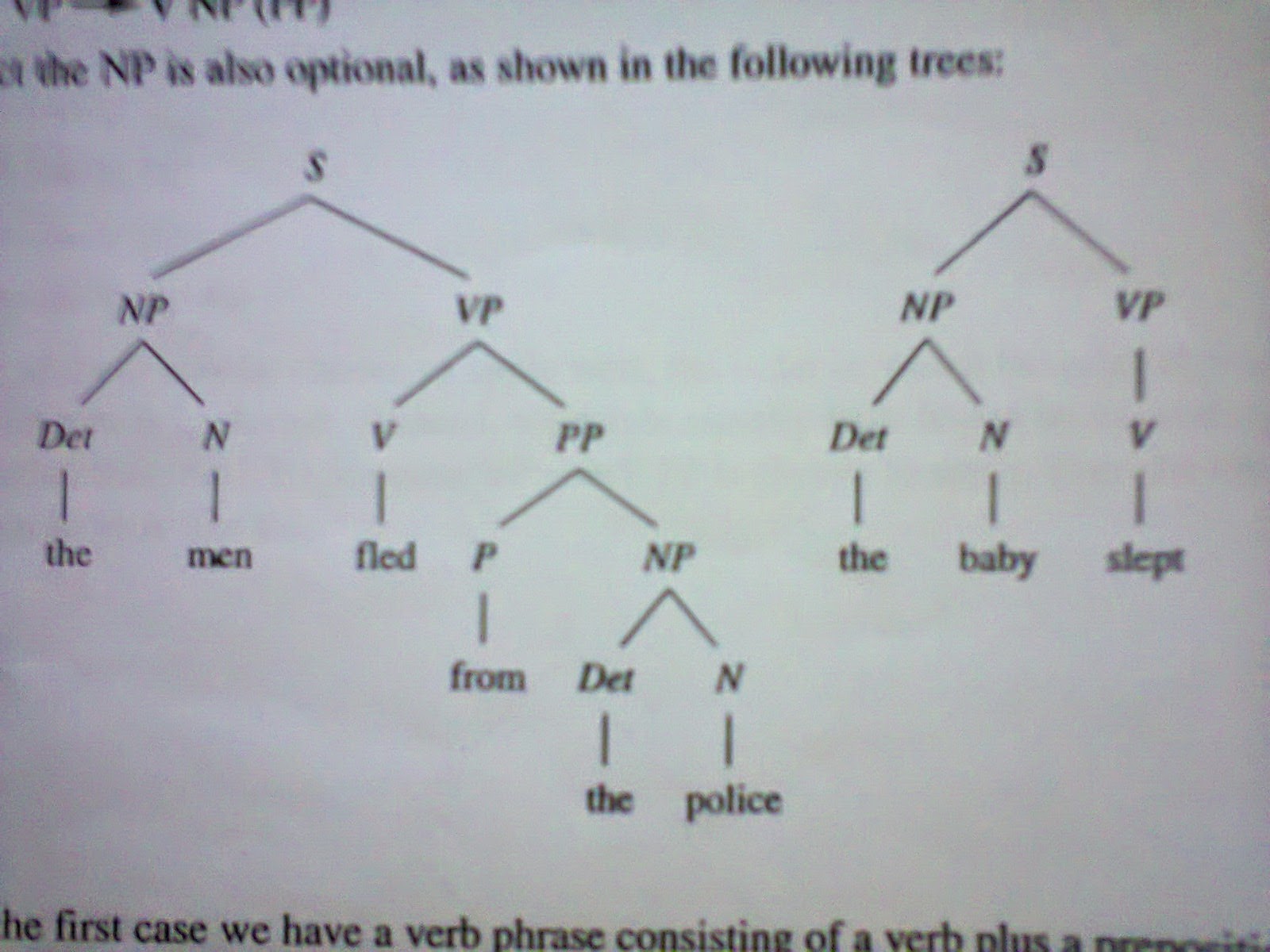
In the firs case we have a verb phrase consisting of a verb plus prepositional phrase, corresponding to the rule VP --- V PP. In the second case, the verb phrase consists of a verb alone, corresponding to the rule VP --- V. All the facts about th verb phrase we have seen so far are revealed in the single rule :
VP --- V (NP) (PP)
This rule states that a verb phrase may consist of a verb followed optionally by a noun phrase and/or a prepositional phrase.
Other rules of English are :
S--- NP VP
PP --- P NP
Michaelis
A phrase structure tree is a formal device for representing speaker knowledge. When we speak we are not aware that we are producing sentences with such structures, but controlled experiments show that we use them in speech production and comprehension. We dom't use the tree structure diagrams per se, but we are unconsciously aware of structures on which these trees are based.
When we look at other phrase structure tree representations of English, we see certain patterns emerging. In ordinary sentences, the S is always subdivided into NP and VP. NPs generally contain nouns; VPs always contain verbs; PPs consist of a preposition followed by a noun phrase.
Of all logically possible tree structures, few actually occur, just as all word combinations do not constitute grammatical phrases or sentences. For example,
a-nonoccurring tree structure in English is :
Both grammatical and ungrammatical trees must be accounted for in the grammar. Again, some kind of formal notation is required, preferably one that reveals speakers knowledge percisely and concisely. To do this, linguists write grammars that include phrase structure rules that specify the constituency of syntactic categories in the language.
For example, in English a noun phrase (NP) can be a determiner (Det) followed by a noun (N). Thus, one of the several allowable NP subtrees looks like this :
The phrase structure rule that makes this explicit can be stated as :
NP -- Det N
This rule conveys two facts :
A noun phrase can be a determiner followed by a noun.
A determiner followed by a noun is a noun phrase
The left side of the arrow is the category whoose components are defined on the right side. The right side of the arrow also shows the linear order of these components. Phrase structure rules make explicit speakers knowledge of the order of words and the grouping of words into syntactic categories.
The phrase structure trees of the previous section show that the following phrase structure rules are part of the grammar of English.
- VP --- V NP
- VP --- V NP PP
Rule (1) and (2) can be summed up in one statement : a verb phrase may be a verb followed by a noun phrase, which may or may not be followed by a prepositional phrase. By putting parentheses aruond the optional element, we can abbreviate rules (1) and (2) with a single rules :
VP --- V NP (PP)
In fact the NP is also optional, as shown in the following trees :
In the firs case we have a verb phrase consisting of a verb plus prepositional phrase, corresponding to the rule VP --- V PP. In the second case, the verb phrase consists of a verb alone, corresponding to the rule VP --- V. All the facts about th verb phrase we have seen so far are revealed in the single rule :
VP --- V (NP) (PP)
This rule states that a verb phrase may consist of a verb followed optionally by a noun phrase and/or a prepositional phrase.
Other rules of English are :
S--- NP VP
PP --- P NP
The infinitude of language
So, naturalists observe, a flea Hath smaller fleas on him prey; And these have smaller fleas still to bitr'em, And so proceed ad infinitum.
Jonathan Swift
There is no longest sentence in any language, because speakers can lengthen any sentence by various means, such as adding an adjective or adding clauses. Even childern know how to produce and understand very long sentences, and know how to make them ever longer, as illustrated by the childern's rhyme about the house that Jack built.
This is the farmer sowing the corn,
that kept the coock that crowed in the morn,
that waked the priest all shaven and shorn,
that married the man all tattered and torn,
that kissed the maiden all forlorn,
that milked the cow with the crumpled horn,
that tossed the dog,
that worried the cat,
that killed the rat,
that ate the malt,
that lay in the house that Jack built.
This rhyme begins with This is the house that Jack built, continues by lengthening it to This is the malt that lay in the house that Jack built, and so on.
Yuo can add any of the following to the beginning of the rhyme and still have a grammatical longer sentence :
I think that .....
What is the name of the unicorn that noticed that .......
Aks someone if ........
Do you know whether .......
This limiyless aspect of language is also reflected in phrase structure trees. We have seen that an NP may appear immediately under a PP, and this PP may occur immediately under a higher NP, as in the man the telescope. The complex (but comprehensible) noun phrase the magician with a pack of cards in his box, as shown in the following phrase structure tree, illustrates that one can repeat the number of NPs under PPs under NPs without a limit.

This phrase structure tree for the noun phrase illustrates that any syntactic category may be represented by a phrase structure tree, that is, be the topmost node. It also illustrates the repetition of the NP within PP within NP and so on.
The NP diagrammed above, though cumbersome, violates no rules of syntax and is a grammatical noun phrase. Moreover, it can be made even longer by expanding the final NP his box by adding another PP of tricks.
The repetition of categories within categories is common in all languages. It allows speakers to use the same syntactic categories several times, with several different functions, in the same sentence. Our brain capacity is finite, able to store only a finite number of categories and rules for their combination. Yet, with these finite means, an infinite a set of sentences can be represented.
All speakers of English have as part of their linguistic competence Their mental grammar the ability to put NPs in PPs in NPs ad infinitum. But as the structures grow longer and longer, they become inceasingly difficult to produce and understand. This could be due for hort-term memory limitations, muscular fatigue, breathlessness, or any number of performane factors.
Thus, while such rules give speakes access to infinitely many sentences, no speaker utters oe hears an infinite number in a lifetime; nor is any sentence infinite length, although in principle there is no upper limit on sentence length. this property of grammars also accounts for the creative aspect of language use, since it permits speakers to produce and understand sentences never spoken before.
Jonathan Swift
There is no longest sentence in any language, because speakers can lengthen any sentence by various means, such as adding an adjective or adding clauses. Even childern know how to produce and understand very long sentences, and know how to make them ever longer, as illustrated by the childern's rhyme about the house that Jack built.
This is the farmer sowing the corn,
that kept the coock that crowed in the morn,
that waked the priest all shaven and shorn,
that married the man all tattered and torn,
that kissed the maiden all forlorn,
that milked the cow with the crumpled horn,
that tossed the dog,
that worried the cat,
that killed the rat,
that ate the malt,
that lay in the house that Jack built.
This rhyme begins with This is the house that Jack built, continues by lengthening it to This is the malt that lay in the house that Jack built, and so on.
Yuo can add any of the following to the beginning of the rhyme and still have a grammatical longer sentence :
I think that .....
What is the name of the unicorn that noticed that .......
Aks someone if ........
Do you know whether .......
This limiyless aspect of language is also reflected in phrase structure trees. We have seen that an NP may appear immediately under a PP, and this PP may occur immediately under a higher NP, as in the man the telescope. The complex (but comprehensible) noun phrase the magician with a pack of cards in his box, as shown in the following phrase structure tree, illustrates that one can repeat the number of NPs under PPs under NPs without a limit.
This phrase structure tree for the noun phrase illustrates that any syntactic category may be represented by a phrase structure tree, that is, be the topmost node. It also illustrates the repetition of the NP within PP within NP and so on.
The NP diagrammed above, though cumbersome, violates no rules of syntax and is a grammatical noun phrase. Moreover, it can be made even longer by expanding the final NP his box by adding another PP of tricks.
The repetition of categories within categories is common in all languages. It allows speakers to use the same syntactic categories several times, with several different functions, in the same sentence. Our brain capacity is finite, able to store only a finite number of categories and rules for their combination. Yet, with these finite means, an infinite a set of sentences can be represented.
All speakers of English have as part of their linguistic competence Their mental grammar the ability to put NPs in PPs in NPs ad infinitum. But as the structures grow longer and longer, they become inceasingly difficult to produce and understand. This could be due for hort-term memory limitations, muscular fatigue, breathlessness, or any number of performane factors.
Thus, while such rules give speakes access to infinitely many sentences, no speaker utters oe hears an infinite number in a lifetime; nor is any sentence infinite length, although in principle there is no upper limit on sentence length. this property of grammars also accounts for the creative aspect of language use, since it permits speakers to produce and understand sentences never spoken before.
Minggu, 06 April 2014
More phrase structure trees
The structure of every sentence is a lesson in logic.
John Stuart Mill
Every language contains sentences of varyinf pharse structure. The following pharse structure tree differs from the previous tree not only in the words that terminate it but also in its syntactic categories and structure.
This tree shows that a verb phrase may also consist of a verb followed by a noun phrase followed by a prepositional phrase (PP). A prepositional phrase is noun phrase followed by a prepositional phrase (PP). A prepositional phrase is shown to consist of a preposition (P) followed by a noun phrase. This tree also illustrated that noun phrases may occur in three different structural positions representing three different grammatical relations: immediately below the S as the subject, immediately below the VP as the direct object immediately below the PP as a prepositional object.

just as tree structures reveal ambiguities in phrases such as synthetic buffalo hides, they also account for sentance ambiguities such ac The boy saw the man with the telescope. One meaning of this sentence ' the boy used a telescope to see the man' is revealed by the phrase structure tree above. The key element is the position of the PP directlky under the VP, where it has an adverbial function and modifies the verb saw.
In its other meaning, 'the boy saw a man who had a telescope', the PP with the telescope is positioned directly under the NP direct object, where it modifies the noun man. Two different interpretations are possible because the rules of syntax permit different structurings of the same linear order of words, as revealed by the two phrase structure trees.

John Stuart Mill
Every language contains sentences of varyinf pharse structure. The following pharse structure tree differs from the previous tree not only in the words that terminate it but also in its syntactic categories and structure.
This tree shows that a verb phrase may also consist of a verb followed by a noun phrase followed by a prepositional phrase (PP). A prepositional phrase is noun phrase followed by a prepositional phrase (PP). A prepositional phrase is shown to consist of a preposition (P) followed by a noun phrase. This tree also illustrated that noun phrases may occur in three different structural positions representing three different grammatical relations: immediately below the S as the subject, immediately below the VP as the direct object immediately below the PP as a prepositional object.
just as tree structures reveal ambiguities in phrases such as synthetic buffalo hides, they also account for sentance ambiguities such ac The boy saw the man with the telescope. One meaning of this sentence ' the boy used a telescope to see the man' is revealed by the phrase structure tree above. The key element is the position of the PP directlky under the VP, where it has an adverbial function and modifies the verb saw.
In its other meaning, 'the boy saw a man who had a telescope', the PP with the telescope is positioned directly under the NP direct object, where it modifies the noun man. Two different interpretations are possible because the rules of syntax permit different structurings of the same linear order of words, as revealed by the two phrase structure trees.
Phrase structure trees
Who climb the Grammar - Tree distinctly knows where noun and verb participle grows.
John Dryden
The fact that child found the puppy belongs to the syntactic category of sentence, that the child and the puppy are noun phrases, that found the puppy is a verb pharse, and so on, can be illustrated in a tree diagram by supplying the name of the syntactic category of each word grouping. These are often referred to as syntactic lables.

A tree diagram with syntactic category information provided is called a phrase structure tree. (it also sometimes referred to as a constituent structure tree.) this tree shows that a sentence is both a lenier string of words and hierarchical structure with phrases nested in phrases.
Three aspects of speaker's syntactic knowledge of sentence structure are disclosed in phrase structure trees :
Every sentence of English and every humman language can be represented by a phrase structure tree that explicitly reveals these properties. These trees represent the linguistic properties that are part of sperakers mental grammars.
The phrase structure tree above is correct, but it is redundant. the word child is repeated three times in the tree, puppy is repeated four times, and so on. We can streamline the tree by writing the word only once at the bottom of the diagram. Only the syntactic categories to which the word belong need to remain at the higher levels.

No information is lost in this simplified version. The syntactic category of each individual word appears immediately above that word. In this way the is shown to be a determiner, 'child a noun, and so on. The lowest categories in the tree, those immediately above the word, are called syntax categories.
The larger syntactic categories, such as verb phrase (VP), are identified as consisting of all the syntactic categories and words below that point or node in the tree. The VP in the above phrase structure tree consists of syntactic category nodes V and NP, this constituent is a noun phrase.
The phrase structure tree also states implicitly what combinations of words are not syntactic categories. For example, since there is no node above the words found and the that connects them, the two words do not constitute a syntactic category, as discussed earlier.
The phrase structure tree also shows that some syntactic categorties are composed of other syntactic categories. the sentence the child foun the puppy consists of a noun phrase, the child and a verb phrase, found the puppy. the verb phrase consists of the verb, found and the noun phrase, the puppy. The determiner the and the noun puppy together constitute a noun phrase, but individually neither is an NP.
A syntactic categories includes all the categories beneath it in the tree. For example, the S in the preceding tree is composed of an NP followed by a VP. An S is also a Det followed by an N followed by a V followed by a Det followed by an N. The 'all' is importan ; an S is not Det N V Det; that would omit the final N, which is part of the S (that is, the boy found the is not a sentence ). Every higher node is said to dominate all the nodes below it.
John Dryden
The fact that child found the puppy belongs to the syntactic category of sentence, that the child and the puppy are noun phrases, that found the puppy is a verb pharse, and so on, can be illustrated in a tree diagram by supplying the name of the syntactic category of each word grouping. These are often referred to as syntactic lables.
A tree diagram with syntactic category information provided is called a phrase structure tree. (it also sometimes referred to as a constituent structure tree.) this tree shows that a sentence is both a lenier string of words and hierarchical structure with phrases nested in phrases.
Three aspects of speaker's syntactic knowledge of sentence structure are disclosed in phrase structure trees :
- the linear order of the words in the sentence
- the groupings of words into particular syntactic categories
- the hierarchical structure of the syntactic categories (for example, a sentence is composed fo a noun phrase followed by a verb phrase, a verb phrase is composed of a verb that may be followed by a noun phrase, and so on )
Every sentence of English and every humman language can be represented by a phrase structure tree that explicitly reveals these properties. These trees represent the linguistic properties that are part of sperakers mental grammars.
The phrase structure tree above is correct, but it is redundant. the word child is repeated three times in the tree, puppy is repeated four times, and so on. We can streamline the tree by writing the word only once at the bottom of the diagram. Only the syntactic categories to which the word belong need to remain at the higher levels.
No information is lost in this simplified version. The syntactic category of each individual word appears immediately above that word. In this way the is shown to be a determiner, 'child a noun, and so on. The lowest categories in the tree, those immediately above the word, are called syntax categories.
The larger syntactic categories, such as verb phrase (VP), are identified as consisting of all the syntactic categories and words below that point or node in the tree. The VP in the above phrase structure tree consists of syntactic category nodes V and NP, this constituent is a noun phrase.
The phrase structure tree also states implicitly what combinations of words are not syntactic categories. For example, since there is no node above the words found and the that connects them, the two words do not constitute a syntactic category, as discussed earlier.
The phrase structure tree also shows that some syntactic categorties are composed of other syntactic categories. the sentence the child foun the puppy consists of a noun phrase, the child and a verb phrase, found the puppy. the verb phrase consists of the verb, found and the noun phrase, the puppy. The determiner the and the noun puppy together constitute a noun phrase, but individually neither is an NP.
A syntactic categories includes all the categories beneath it in the tree. For example, the S in the preceding tree is composed of an NP followed by a VP. An S is also a Det followed by an N followed by a V followed by a Det followed by an N. The 'all' is importan ; an S is not Det N V Det; that would omit the final N, which is part of the S (that is, the boy found the is not a sentence ). Every higher node is said to dominate all the nodes below it.
Syntactic categories
Each of the grouping in the tree diagraam of the hild found the puppy is a member of a large family of similar expression. For example, the child belongs to a family that includes the police officer, your neighbour, this black cat, he, and countless others. Each member of this family can be substituted for the child without affecting the grammaticality of the sentence, although the meaning of course would change.
A police officer found the puppy.
Your neighbour found the puppy.
This black cat found the puppy.
He found the puppy.
A family of expressions that can substitute for one another without loss of grammaticality is called a syntactic category.
The child, a police officer, and so on belong to the syntactic category noun phrase (NP), one of several syntactic categories in English and every other language in the world. Noun phrases may function as a subject or as various object in a sentence, and they contain some form of a noun (common nouns such as boy, proper nouns such as John, or pronouns such as he ). Since he is a single word, you may question our calling it a phase, but technically a syntatic phrase can consist of one or more words. In fact an NP can even include a verbal complex as shown by :
Romeo, who was a montague, loved juliet who was a capulet.
The NP subject of this sentence is romeo, who was a montague, and the object, also an NP, is juliet who was a capulet.
Part of the syntactic component of a grammar is the specification of the syntactic categories in the language, since this constitutes part of speaker's knowledge. That is, speakers of English know that items (a), (b), (e), (f), (g), and (i) in (1) are noun phrases even if they have never heard the term before.
(1)
Yuo can test this claim by inserting each expression into the context : 'who discovered ____________ ?' and ' ________________ was seen by everyone'.
Only those sentences in which NP's are inserted are grammatical, because only NP's can function as subjects and objects.
There are other syntactic categories. The expression found the puppy is a verb phrase (VP). Verb phrases always contain a verb (V), which may be followed by other categories, such as a noun phrase or prepositional phrase (PP). This shows that one syntactic category may contain other syntactic categories. In (2), the verb phrases are those that can complete the sentence ' The child ___________
(2)
Inserting (a), (c), (e), (f), (g), and (h) will produce grammatical sentences whereas the insertion of (b) or (d) would result in an ungrammatical string. Thus, (a), (c), (e), (f), (g) and (h) are verb phrases.
Other syntactiv categories are sentence (S), determiner (Det), adjective (Adj), noun ( N), pronoun (Pro), preposition (P), prepositional phrase (PP), adverb (Adv), auxiliary verb (Aux), and verb (V). Some of these syntactic categories have traditionally been called 'parts of speech'. All languages have such syntactic categories ; in fact, categories such as noun, verb, pronoun, and noun phrase are universally found in the grammars of all hummen languages. Speakers know the syntactic categories of their language, even if they do not know the techincal terms.
A police officer found the puppy.
Your neighbour found the puppy.
This black cat found the puppy.
He found the puppy.
A family of expressions that can substitute for one another without loss of grammaticality is called a syntactic category.
The child, a police officer, and so on belong to the syntactic category noun phrase (NP), one of several syntactic categories in English and every other language in the world. Noun phrases may function as a subject or as various object in a sentence, and they contain some form of a noun (common nouns such as boy, proper nouns such as John, or pronouns such as he ). Since he is a single word, you may question our calling it a phase, but technically a syntatic phrase can consist of one or more words. In fact an NP can even include a verbal complex as shown by :
Romeo, who was a montague, loved juliet who was a capulet.
The NP subject of this sentence is romeo, who was a montague, and the object, also an NP, is juliet who was a capulet.
Part of the syntactic component of a grammar is the specification of the syntactic categories in the language, since this constitutes part of speaker's knowledge. That is, speakers of English know that items (a), (b), (e), (f), (g), and (i) in (1) are noun phrases even if they have never heard the term before.
(1)
- a bird
- the red banjo
- have a nice day
- with a balloon
- the woman who was laughing
- it
- johnwent
- that the earth is round
Yuo can test this claim by inserting each expression into the context : 'who discovered ____________ ?' and ' ________________ was seen by everyone'.
Only those sentences in which NP's are inserted are grammatical, because only NP's can function as subjects and objects.
There are other syntactic categories. The expression found the puppy is a verb phrase (VP). Verb phrases always contain a verb (V), which may be followed by other categories, such as a noun phrase or prepositional phrase (PP). This shows that one syntactic category may contain other syntactic categories. In (2), the verb phrases are those that can complete the sentence ' The child ___________
(2)
- saw a clown
- a bird
- slept
- smart
- is smart
- found the cake
- found the cake in the cupboard
- realised that the earth was round
Inserting (a), (c), (e), (f), (g), and (h) will produce grammatical sentences whereas the insertion of (b) or (d) would result in an ungrammatical string. Thus, (a), (c), (e), (f), (g) and (h) are verb phrases.
Other syntactiv categories are sentence (S), determiner (Det), adjective (Adj), noun ( N), pronoun (Pro), preposition (P), prepositional phrase (PP), adverb (Adv), auxiliary verb (Aux), and verb (V). Some of these syntactic categories have traditionally been called 'parts of speech'. All languages have such syntactic categories ; in fact, categories such as noun, verb, pronoun, and noun phrase are universally found in the grammars of all hummen languages. Speakers know the syntactic categories of their language, even if they do not know the techincal terms.
Sentence structure
I really do not know that anything has ever been more exciting than diagramming sentences.
Gerude Stein.
Syntactic rules determine the order of words in a sentence, and how the words are grouped. The words in the sentence
The child found the puppy
may be grouped into (the child) and (found the puppy), corresponding to the subject and predicate of the sentence. A further division gives (the child) ((found) (the puppy)), and finally the individual words :
((the) (child)) ((found) (the) (puppy)).
It is easier to see the parts and subparts of the sentence in a tree diagram :

The 'tree' is upside down with its ' root' being the entire sentence, the child found the puppy, and its 'leaves' being the individual words, the, child, found, the, puppy. The tree conveys the same information as the nested parentheses, but more perspicuously. the groupings and subgroupings reflect the hierarchical structure of the tree.
The tree diagram shows among other things that the phrase found the puppy is naturally devided into two branches, the two groups, found and the puppy. A different division, say found the and puppy, is unnatural in the sense that speakers of Englis would not use found the by itself or as an answer to the question 'what didi you find ?' An answer might be the puppy but not found the. in fact, found the cannot be an answer to any question. A word such as found never occours in a single group followed only by the.
Other sentences with the same meaning as the original sentence can be formed, for example :
It was the puppy the child found.
The puppy was found by the child.
In all such arrangements the puppy remains inact. Found the does not remain intact, nor can the sentence be changed by moving found the around. All these facts show that the puppy is a natural structure whereas found the is not.
Only one tree representation consistent with an English speaker's syntactic knowledge can be drawn for the sentence The child found the puppy. But the phrase synthetic buffalo hides has two such trees, one of each of its two meaning :

Every sentence has one or mare corresponding constituent structures coposed of hierarchically arranged parts called constituents. These may be graphically depicted as tree structures. Each tree corresponds to one of the possible meanings. Structural ambiguity can be explicitly accounted for by multiple tree structures.
Gerude Stein.
Syntactic rules determine the order of words in a sentence, and how the words are grouped. The words in the sentence
The child found the puppy
may be grouped into (the child) and (found the puppy), corresponding to the subject and predicate of the sentence. A further division gives (the child) ((found) (the puppy)), and finally the individual words :
((the) (child)) ((found) (the) (puppy)).
It is easier to see the parts and subparts of the sentence in a tree diagram :
The 'tree' is upside down with its ' root' being the entire sentence, the child found the puppy, and its 'leaves' being the individual words, the, child, found, the, puppy. The tree conveys the same information as the nested parentheses, but more perspicuously. the groupings and subgroupings reflect the hierarchical structure of the tree.
The tree diagram shows among other things that the phrase found the puppy is naturally devided into two branches, the two groups, found and the puppy. A different division, say found the and puppy, is unnatural in the sense that speakers of Englis would not use found the by itself or as an answer to the question 'what didi you find ?' An answer might be the puppy but not found the. in fact, found the cannot be an answer to any question. A word such as found never occours in a single group followed only by the.
Other sentences with the same meaning as the original sentence can be formed, for example :
It was the puppy the child found.
The puppy was found by the child.
In all such arrangements the puppy remains inact. Found the does not remain intact, nor can the sentence be changed by moving found the around. All these facts show that the puppy is a natural structure whereas found the is not.
Only one tree representation consistent with an English speaker's syntactic knowledge can be drawn for the sentence The child found the puppy. But the phrase synthetic buffalo hides has two such trees, one of each of its two meaning :
Every sentence has one or mare corresponding constituent structures coposed of hierarchically arranged parts called constituents. These may be graphically depicted as tree structures. Each tree corresponds to one of the possible meanings. Structural ambiguity can be explicitly accounted for by multiple tree structures.
Langganan:
Postingan (Atom)