The science of speech sounds is called phonetics. It aims to provide the set of features, or properties, that can describe all sounds in humman language.
When we speak, the physical sounds we produce are continuous stretches of sound, which are the physical representation of strings of discrete linguistic segments. Knowledge of a language permits one to segment the continuous sound into linguistic units words, morphemes, and sounds.
The discrepancy between spelling and sounds in English and other languages motivated the development of phonetic alphabets in which one letter corresponds to one sound. The major phonetic alphabet in use is that of the International Phonetic Association (IPA), which includes modified Roman letters and diacritics by means of which the sounds of all human languages can be represented. To distinguish between the orthography (or spelling) of words and their pronunciation, phonetic transcriptions may be put between square brackets, as [fənetɪk] for phonetic.
All English speech sounds are produced by the movement of lung air through the vocal tract through the glottis or vocal cords, up the pharynx, through the oral cavity and out through the mouth and sometimes the nose. All human speech sounds fall into classes according to their phonetic properties or features; that is, according to how they are produced.
All speech sounds are either consonants or vowels, and all consonants are either obstruents or sonorants. Consonants are distinguished according to where they are articulated in the vocal tract theit place of articulation, including bilabial, labiodental, alveolar, palatal, velar, uvular, and glottal.
Speech sounds are also classified according to their manner of articulation. They may be voiced or voiceless, oral or nasal; they may be stops, fricatives, lateral, glides, or vowels. During the production of voiced sounds the vocal cords or glottis are together and vibrating whereas in voiceless sounds the glottis is open and non-vibrating. Voiceless sounds may be also aspirated or unaspirated. In the production of aspirated sounds the vocal cords remain apart for a brief time after the stop closure is released, thus producing a puff of air at the time of the release. Some classes of sounds combine to form the larger classes such as labials, coronals, anteriors, and sibiliants.
Vowels from the nucleus of syllables. They differ according to length: long or short; and the position of the tongue: high, mid, or low tongue; front or back of the tongue. Vowels may also be stressed (longer, higer in pitch, and louder) or unstressed.
In sign languages, instead of phonetic features there are three classes of primes hand configuration, the motion of the hand(s) toward or away from the body, and the place of articulation, or the focus of the sign's movements.
In many languages the pitch of the vowel or syllable linguistically significant: for example, two words may contrast in meaning if one is produced with a higer pitch and another with lower pitch. Such languages are called tone languages as opposed to intonation languages, in which pitch is never used to contrast words. In intonation languages, however, the rise and fall of pitch may contrast meaning of sentences. In English the statement Mary is a teacher will end with a fall in pitch, bur in the question Mary is a techer ? the pitch will rise.
Length, pitch, and loudness are prosodic or suprasegmental features. Diacritics to specify such properties as nasalisation, length, voicelessness, syllabicity, stress, tone, and rounding may be combined with the phonetic symbols for more detailed phonetic transcriptions.
By mean of these phonetic features all speech sounds of all languages can be described.
Tampilkan postingan dengan label Phonetics. Tampilkan semua postingan
Tampilkan postingan dengan label Phonetics. Tampilkan semua postingan
Selasa, 15 April 2014
Sign language primes
Just as sign languages have their own morphological, syntactic and semantic system, they also have their equivalent of phonetics and phonology. The formal units corresponding to phonetic elements of spoken language are referred to as primes. The sign of the language that correspond to morphemes or words can be specified by primes of three different classes: hand configuration; the motion of the hand(s) toward or away from the body; and the place of articulation, or the locus, of the sign's movement.

Senin, 14 April 2014
Phonetic symbols and spelling correspondences
Table 6.5 shows the sound/spelling correspondences for Australian English consonants and vowels. (All possible spellings are not given; these, however, should provide enough examples to help you pair sounds and English orthography.) We have included the symbols for the voiceless aspirated stops to illustrate that what speakers usually consider as one sound may phonetically be two.

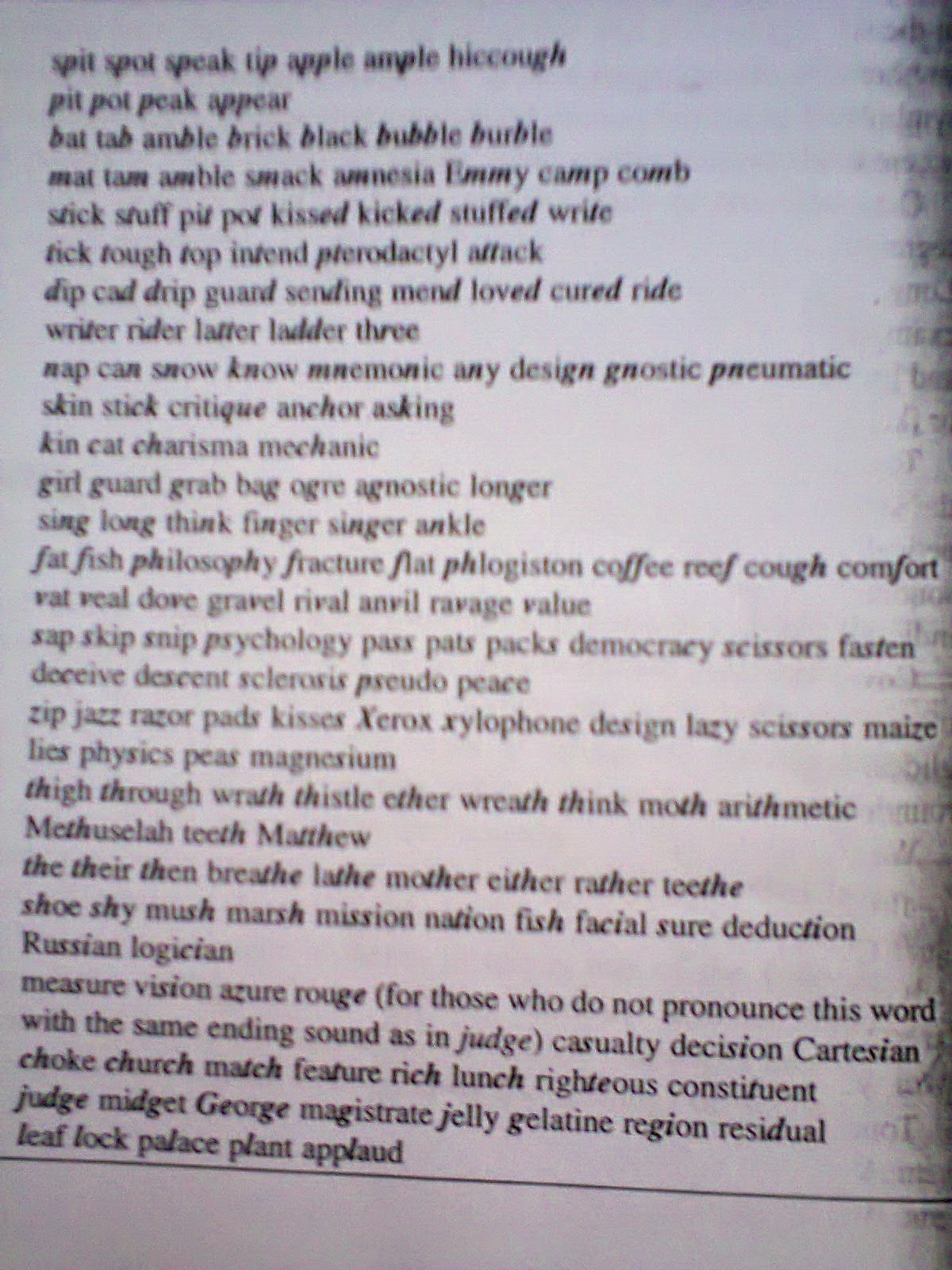


The symbol given in table 6.5 are not sufficient to represent the pronunciation of words in all languages. The symbol [x], for example, is needed for the voiceless velar fricative in the German word Bach, and [R] for the French uvular fricative. English does not have rounded front vowels, but languages such as French and Swedish do. French rounded front vowels can be symbolised as follows :

The symbol given in table 6.5 are not sufficient to represent the pronunciation of words in all languages. The symbol [x], for example, is needed for the voiceless velar fricative in the German word Bach, and [R] for the French uvular fricative. English does not have rounded front vowels, but languages such as French and Swedish do. French rounded front vowels can be symbolised as follows :
Diacritics
In the section of the nasalisation, prosodic feature and tone, we presented a numbee of diacritic marks which can be used to modify the basic phonetic symbols. A [~] over the vowel was used to mark vowel nasalisation, an acute accent to show stress and various accent marks to show tones.
Other diacritics help distinguish long from short phonetic segments. A long segment may be indicated by a [:] placed after a symbol or by doubling the symbol. Long vowels or consonants are sometimes called geminates. In Italian, foe example, both long or geminate and short consonants occur: [papa] means 'Pope' and [pap:a] or [pappa} means 'porridge'. In Korean, [kul] means 'oyster' and [ku:l] or [kuul] means 'tunnel'.
To differentiate a voiceless lateral liquid such as the ll in the Welsh name Lloyd the symbol [.] is placed under the segment: thus Lloyd in Welsh would be phonetically transcribed as [l.ɔɪd]. The devoiced sonorants that occur in English after voiceless stops and fricatives are similarly indicated: please [p.liz], smile [sm.aɪl].
Cover symbol are used when a class of sounds is referred to. A capital C is often used to represent the class of consonant may also specified as C1, and a rounded consonant that often occurs before a rounded vowel by a superscript w.
We can summarise these diacritics and additional symbols as follows :

Other diacritics help distinguish long from short phonetic segments. A long segment may be indicated by a [:] placed after a symbol or by doubling the symbol. Long vowels or consonants are sometimes called geminates. In Italian, foe example, both long or geminate and short consonants occur: [papa] means 'Pope' and [pap:a] or [pappa} means 'porridge'. In Korean, [kul] means 'oyster' and [ku:l] or [kuul] means 'tunnel'.
To differentiate a voiceless lateral liquid such as the ll in the Welsh name Lloyd the symbol [.] is placed under the segment: thus Lloyd in Welsh would be phonetically transcribed as [l.ɔɪd]. The devoiced sonorants that occur in English after voiceless stops and fricatives are similarly indicated: please [p.liz], smile [sm.aɪl].
Cover symbol are used when a class of sounds is referred to. A capital C is often used to represent the class of consonant may also specified as C1, and a rounded consonant that often occurs before a rounded vowel by a superscript w.
We can summarise these diacritics and additional symbols as follows :
Tone and intonation
Speaker of all languages vary the pitch of their voices when they talk, and the pitch produced depends upon how fast the vocal cords vibrate; the faster they vibrate, the higer the pitch.
The way pitch is used linguistically differs from language to language. In English, it does not much matter whether you say cat with a high pitch or a low pitch. It will still mean 'cat'. However, if you say [ba] with a high pitch in Nupe (a language spoken in Nigeria), it will mean 'to be sour', whereas if you say [ba] with a low pitch, it will mean 'to count'. Languages that use the pitch of individual syllables to contrast meanings are called tone languages.
Most of the languages in the world ate tone languages. There are more than 100 tone language in Africa alone; many languages of Asia, such as Chinese, Thai, and Brumese, are tone languages, as are many Native American languages.
Thai is a language that has contrasting pitch, or tones. The same string of 'segmental' sounds represented by [naa] will mean different things when spoken with a low pitch, a mid pitch, a high pitch, a falling pitch fromm high to low, or a rising pitch from low to high. Thai therefore has five tones :

We can use these diacritics above the vowels to represent the tonal contrasts in any language where the pitch of the vowel is important in conveying meaning, as illustrated by the three contrastive tones in Nupe :

In Akan sometimes called Twi, the major language of Gana, two tones are used for contrast in two-syllable words :

In some tone languages the pitch of each tone is 'level'; in others, the direction of the pitch (whether it glides from high to low, or low to high) is important, Tones that 'glide' are called contour tones; tones that do not are called level or register tones. The contour tones of Thai are represented by using a high tone followed by a low tone for a falling glide, and a low followed by a high for a rising tone.
In a tone language it is not the absolute pitch of the syllables that is important but the relations among the pitches of different syllables. After all, some individual speakers have high-pitched voices, other low-pitched, and others medium-pitched. In many tone languages we find a falling-off of the pitch, or a 'downdrifting'. In the following sentence in Twi, the relative pitch rather than the absolute pitch is important :

The lowering of the pitch is called downdrift. In languages with downdrift and any tone languages in Africa are downdrif languages a high tone that occurs after a low tone, or a low tone after a high tone, is lower in pitch than the preceding similarly marked tone. Notice that the first high in the sentence is given a pitch value 7. The next high tone (which occurs after an intervening low tone) is 6; that is, it is lower in pitch that the first high tone.
This example shows that in analysing tones, just as in analysing segnents, all the physical properties need not be considered; only essential features are important in language in this case, whether the one is 'high' or 'low' in relation to the other pitches, but not the specific pitch of that tone.
Languagea that are not tone languages, such as English, are called intonation languages. The pitch contour of the utterance varies, but in an intonation language, as opposed to a tone language, pitch is not used to distinguish words from each other.
The way pitch is used linguistically differs from language to language. In English, it does not much matter whether you say cat with a high pitch or a low pitch. It will still mean 'cat'. However, if you say [ba] with a high pitch in Nupe (a language spoken in Nigeria), it will mean 'to be sour', whereas if you say [ba] with a low pitch, it will mean 'to count'. Languages that use the pitch of individual syllables to contrast meanings are called tone languages.
Most of the languages in the world ate tone languages. There are more than 100 tone language in Africa alone; many languages of Asia, such as Chinese, Thai, and Brumese, are tone languages, as are many Native American languages.
Thai is a language that has contrasting pitch, or tones. The same string of 'segmental' sounds represented by [naa] will mean different things when spoken with a low pitch, a mid pitch, a high pitch, a falling pitch fromm high to low, or a rising pitch from low to high. Thai therefore has five tones :
In Akan sometimes called Twi, the major language of Gana, two tones are used for contrast in two-syllable words :
In some tone languages the pitch of each tone is 'level'; in others, the direction of the pitch (whether it glides from high to low, or low to high) is important, Tones that 'glide' are called contour tones; tones that do not are called level or register tones. The contour tones of Thai are represented by using a high tone followed by a low tone for a falling glide, and a low followed by a high for a rising tone.
In a tone language it is not the absolute pitch of the syllables that is important but the relations among the pitches of different syllables. After all, some individual speakers have high-pitched voices, other low-pitched, and others medium-pitched. In many tone languages we find a falling-off of the pitch, or a 'downdrifting'. In the following sentence in Twi, the relative pitch rather than the absolute pitch is important :
The lowering of the pitch is called downdrift. In languages with downdrift and any tone languages in Africa are downdrif languages a high tone that occurs after a low tone, or a low tone after a high tone, is lower in pitch than the preceding similarly marked tone. Notice that the first high in the sentence is given a pitch value 7. The next high tone (which occurs after an intervening low tone) is 6; that is, it is lower in pitch that the first high tone.
This example shows that in analysing tones, just as in analysing segnents, all the physical properties need not be considered; only essential features are important in language in this case, whether the one is 'high' or 'low' in relation to the other pitches, but not the specific pitch of that tone.
Languagea that are not tone languages, such as English, are called intonation languages. The pitch contour of the utterance varies, but in an intonation language, as opposed to a tone language, pitch is not used to distinguish words from each other.
Prosodic suprasegmental features
The production of speech sounds may also involve other methods that require special features for adequate description. For example, vowels or consonants may be long or short in duration. A vowel can be lengthened beyond its 'characteristic' length of prolonging it. A consonant is made long by maintaining the closure or obstruction for a longer period of time.
When we speak we also change the pitch of our voice. The pitch producted depends upon how fast the vocal cords vibrate; the faster they vibrate, the higer pitch. In physical or acoustic terms, pitch is reffered to as the fundamental frequency of the sound signal.
We are also able to change the loudness of the sounds and sound sequences. In many languages, some syllables or vowels are produced with a chang in pitch (usually higer), more loudly, and longer than other vowels in the word or sentence. They are referred to as stressed or accented syllables or vowels.
For example, the first syllable of digest, the noun meaning 'summation of articles' or a 'journal', is stressed, while in digest, the verb meaning 'to absorb food', the second syllable is stressed. Stress can be marked in a number of ways, such as by putting an 'accent' mark over the stressed vowel.
Features such as length, pitch, and the complex feature stress are used in various languages to distinguish the meaning of words and sentences. Such feature are often referred to as prosodic or suprasegmental features.
When we speak we also change the pitch of our voice. The pitch producted depends upon how fast the vocal cords vibrate; the faster they vibrate, the higer pitch. In physical or acoustic terms, pitch is reffered to as the fundamental frequency of the sound signal.
We are also able to change the loudness of the sounds and sound sequences. In many languages, some syllables or vowels are produced with a chang in pitch (usually higer), more loudly, and longer than other vowels in the word or sentence. They are referred to as stressed or accented syllables or vowels.
For example, the first syllable of digest, the noun meaning 'summation of articles' or a 'journal', is stressed, while in digest, the verb meaning 'to absorb food', the second syllable is stressed. Stress can be marked in a number of ways, such as by putting an 'accent' mark over the stressed vowel.
Features such as length, pitch, and the complex feature stress are used in various languages to distinguish the meaning of words and sentences. Such feature are often referred to as prosodic or suprasegmental features.
Syllabic sounds
Traditionally it has been difficult to provide a precise definition of what constitutes a syllable, although speakers seem to be able to determine the syllabic structure of a word. From an auditory point of view, syllables have peaks of sonorance (which are also difficult to define). Every vowel constitutes a syllable.
Laterals and nasals can be syllabic that is, they may constitute sperate syllables, as in the words medal [medl], muttton [mʌtmn], or rhythm [riðm]. The diacritic [.] under the sound indicates that it is syllabic.
Laterals and nasals can be syllabic that is, they may constitute sperate syllables, as in the words medal [medl], muttton [mʌtmn], or rhythm [riðm]. The diacritic [.] under the sound indicates that it is syllabic.
Consonants and vowels
As stated earlier, the sounds of all the languages of the world fall into two major natural classes consonants and vowels. consonants include a number of subclasses: stops (including affricates an nasals), fricatives, laterals and glides. the class of vowels include oral, nasal front central, back, high, mid, and low vowels.
Nasal and laterals, for the reasons given in the previous section, are sonorants; yet they resemble the obstruents in that the oral cavity is constricted during their articulation. Obstruents, laterals and nasals from a natural class of consonantal sounds that differ phonetically from the vocalic (or non-consonantal) class of vowels and glides.
Labial : [p] [b] [m] [f] [v]
The class of labial consonants includes the class of bilabial sounds [p] [b] [m] as well as the labiodentals [f] and [v]. Bilabial and labial sounds are those articulated with the involvement of the lips.
Coronals : [t] [d] [n] [s] [z] [ʃ] [ʒ] [tʃ] [dʒ]
Coronals include the alveolars [t] [d] [n] [s] [z] the palatal [ʃ] [ʒ] and the affricates [tʃ] [dʒ]. These sounds are articulated by raising the tongue blade towards the hard palate.
Anterior
Anterior sounds are consonants produced by the front of the tongue, in in fron of the palato-alveolar area. They include bilabials, labiodentals, and alveolars.
Sibilants : [s] [z] [ʃ] [ʒ] [tʃ] [dʒ]
Another class of consonantal sounds is characterised by an acoustic rather than an articulatory property of its members. The friction created in the production of the fricatives in the words sit [sɪt] zip [zɪp], shoe [ʃu], leisure [leʒə], and measure [meʒə], and the affricates in the words church [tʃɜtʃ] and judge [dʒʌdʒ] causes a 'hissing' sound. These sounds are in a class of sibiliants.
Nasal and laterals, for the reasons given in the previous section, are sonorants; yet they resemble the obstruents in that the oral cavity is constricted during their articulation. Obstruents, laterals and nasals from a natural class of consonantal sounds that differ phonetically from the vocalic (or non-consonantal) class of vowels and glides.
Labial : [p] [b] [m] [f] [v]
The class of labial consonants includes the class of bilabial sounds [p] [b] [m] as well as the labiodentals [f] and [v]. Bilabial and labial sounds are those articulated with the involvement of the lips.
Coronals : [t] [d] [n] [s] [z] [ʃ] [ʒ] [tʃ] [dʒ]
Coronals include the alveolars [t] [d] [n] [s] [z] the palatal [ʃ] [ʒ] and the affricates [tʃ] [dʒ]. These sounds are articulated by raising the tongue blade towards the hard palate.
Anterior
Anterior sounds are consonants produced by the front of the tongue, in in fron of the palato-alveolar area. They include bilabials, labiodentals, and alveolars.
Sibilants : [s] [z] [ʃ] [ʒ] [tʃ] [dʒ]
Another class of consonantal sounds is characterised by an acoustic rather than an articulatory property of its members. The friction created in the production of the fricatives in the words sit [sɪt] zip [zɪp], shoe [ʃu], leisure [leʒə], and measure [meʒə], and the affricates in the words church [tʃɜtʃ] and judge [dʒʌdʒ] causes a 'hissing' sound. These sounds are in a class of sibiliants.
Langganan:
Postingan (Atom)